Don't Let AI Eat Your Students' Brains
- May 13
- 2 min read
Updated: Jun 15
Future-Ready Learning: AI, Pedagogy and the Human Experience
There's a moment in this webinar where Dr. Neil Hopkin says something that stops you in your tracks.
"AI isn't going to come and eat your job," he tells the panel. "But if schools don't get ahead of this, it's going to come and eat your kids' brains."
It's a provocation, but it's also a diagnosis. And it's one that four of the world's leading voices on AI and education spend the next hour unpacking with remarkable candour, warmth, and practical wisdom.
What this conversation is really about:
This isn't a webinar about tools. There are no product demos, no five-step frameworks, no breathless talk of disruption. What you'll find instead is a genuinely rare thing: a group of experienced educators who have been working at the intersection of AI and learning since day one, thinking aloud together about what it actually means to do this well.
Darren Coxon, who was one of the first school leaders to bring ChatGPT into the classroom, talks about what it means for schools to be intentional rather than reactive. Stephanie, Director of Teaching and Learning at DSB International School in Mumbai, describes how she spent a full year embedding metacognitive practice before introducing AI to students at all. Russell Cailey draws on his experience running a nomadic school across twelve countries to ask a deceptively simple question: what are schools actually for? And Dr. Neil Hopkin frames the whole thing around a tension every educator will recognise. The tension between compression and depth, between speed and the kind of slow, friction-rich thinking that actually builds a mind.
Inside the full recording, the conversation goes somewhere most AI-in-education discussions don't. It covers questions of equity — who will learn to leverage AI and who will merely consume it, and what that gap means for the children in our schools right now. It explores what we lose when we remove the effort from learning, and what the analogy of Ozempic can teach us about outsourcing our cognitive appetite. And it closes with something genuinely hopeful: simple, practical starting points for any teacher who wants to build their AI literacy without being overwhelmed — including the moment each panellist knew AI wasn't going away, and why one A-level student's 37 iterative prompts might be the most encouraging thing anyone said all webinar.
And if you'd rather get the headlines first, we've also distilled the panel's sharpest thinking into a key takeaways resource — covering the central philosophical choice every school needs to make, the risks the panel named that rarely make it into the usual conversation, and the equity gap opening up between students right now.
Both the full recording and the key takeaways resource are available below, just pop in your details to access them.
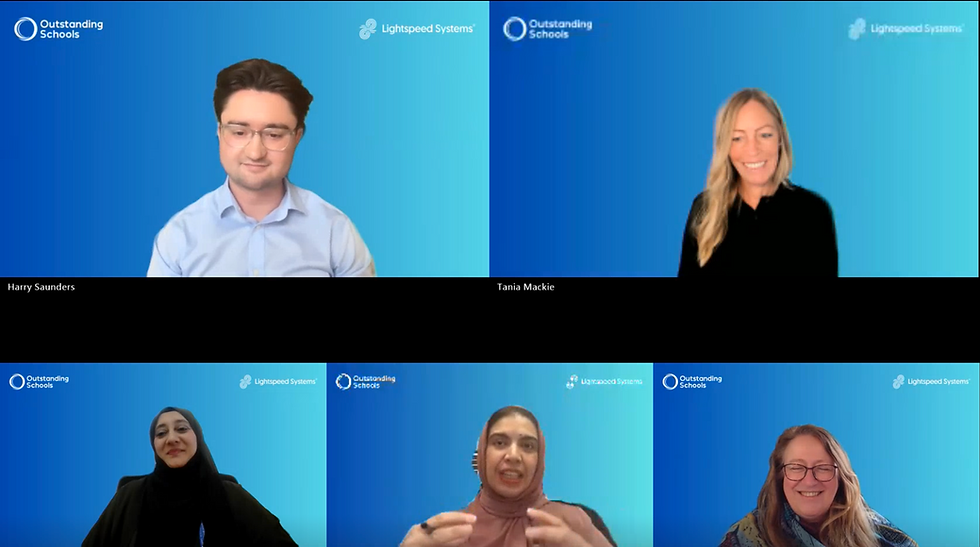
Future-Ready Learning: AI, Pedagogy and the Human Experience is part of the Outstanding Schools webinar series. Featuring Darren Coxon, Stephanie (DSB International School), Dr. Neil Hopkin (Fortes Education) and Russell Cailey (Elham Studio), hosted by Dr. Helen Wright.

Comments